I recently went on a journey to grieve my friend, Jane. She was my running partner on Sundays but Jane really loved to hike. When Jane became ill, she couldn’t run or even walk around town on a Sunday morning like we regularly did. I struggled to find a way to honor my friend after she died. At first I was going to run a half marathon for her but every time I tried to run, I couldn’t get very far and would turn back home. It just wasn’t the same without Jane. It seemed like the best way to work through my emotions was to walk them off, take a hike that Jane would have enjoyed.
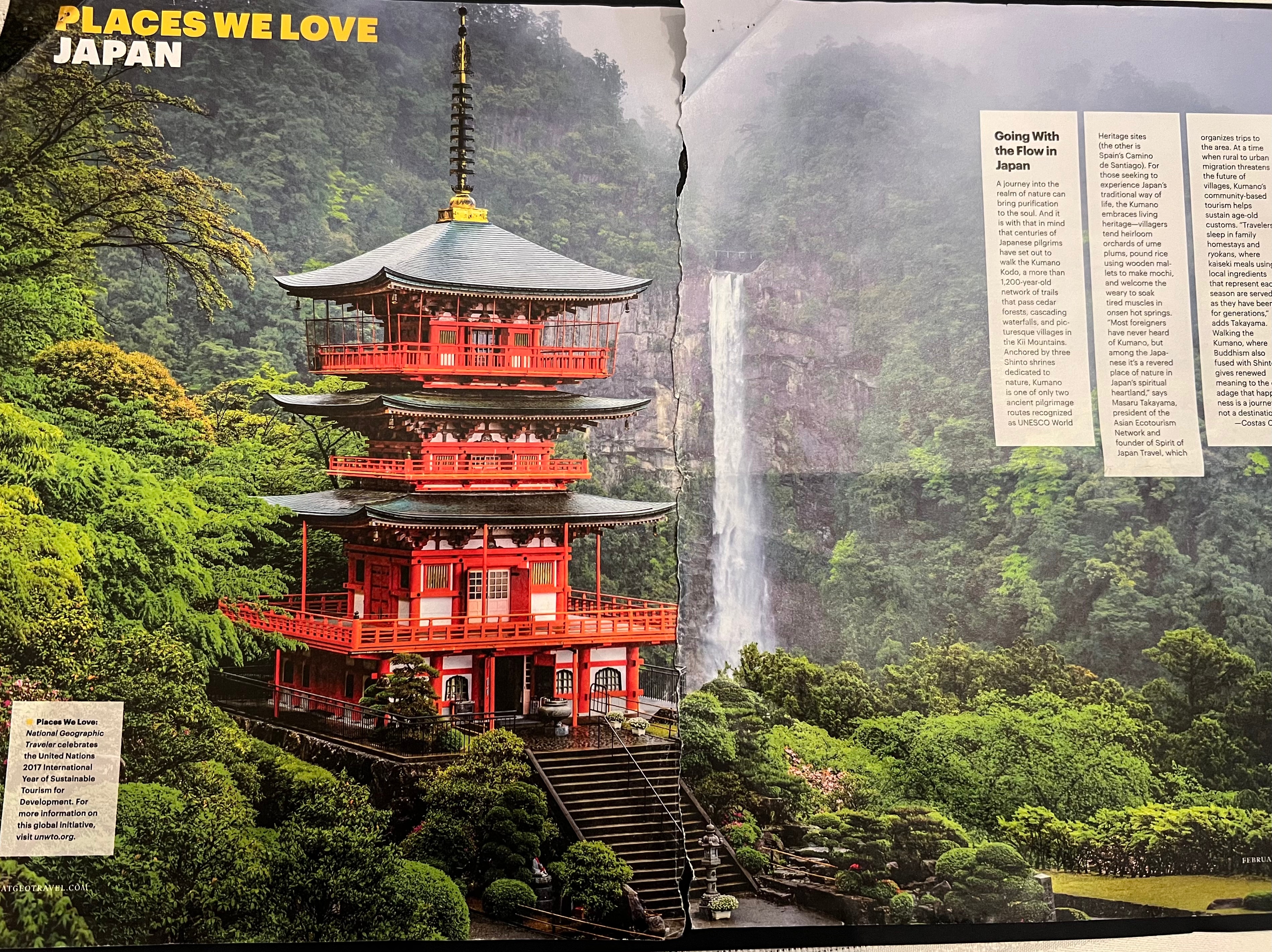
Several years ago I read an article in Travel and Leisure magazine about the Kumano Kodo, a 1,200 year-old network of trails through the Kii Mountains that pass cedar forests, waterfalls, and small villages with hot springs leading to three Shinto shrines dedicated to nature. Kumano Kodo is one of only two ancient pilgrimage routes recognized as UNESCO World Heritage sites (the other being Spain’s Camino de Santiago). The photo in the article of the Three Storied Pagoda with the Nachi Waterfall behind it was an image that lodged in my brain. I vowed to myself I would one day visit it. (I learned about the Camino much later and ended up walking the Camino Portuguese route in 2019.) While cleaning out some files, I came across that article. It was then I decided walking Kumano Kodo was the perfect way to honor Jane.
Although I could not stop my friend’s deteriorating health and ultimate death, I needed to cope with my grief and incredible sadness that came with losing my friend. I traveled nearly 7,000 miles to Japan to take a hike in an area where few people speak English. I couldn’t read most signs, easily ask questions, or respond to requests. I came to Japan alone with my friend on my mind, hoping that each step along the way would help me find a way to move forward from a depression that’s kept me from living a life denied my friend, one full of nature, adventure, and love.
Since I had already completed a Camino route in Spain (here is a link to my post on my Camino), I would be recognized as a Dual Pilgrim when I finished the Kumano Kodo. I chose part of the Nakahechi route, which was used by the Imperial family on pilgrimage from Kyoto starting in the 10th century. The Nakahechi route is an approximately 38km trail beginning at Takijiri-oji and traversing the Kii Peninsula east towards the grand shrine at Kumano Hongu Taisha. In order to become a Dual Pilgrim, I would have to collect 18 stamps in my Kumano Kodo credential at various shrines and sacred sites along the way. In Hongu I would need to present both my stamped Kumano Kodo credential and proof of completion of my Camino to receive my Dual Pilgrim certificate. I planned on completing the 38km route over three days.
For Day 1 I arranged for a guide. My guide, Waka, was a young woman who was very knowledgable. She provided explanations of the historical and spiritual significance of the Kumano Kodo and the shrines we passed along the way. Waka also gave me an idea of what to expect when I walked the remainder of the route alone. Having clear expectations would help me prepare mentally for the trek ahead. Only 15 minutes into our climb, we came upon a set of boulders that form a cave-like tunnel called Tainai-kugauri. Pilgrims are encouraged to crawl through the tunnel to the other side, like passing through nature’s womb and being reborn. After watching a tall man struggle to make it through the passage, I decided being born once was enough for me (he ultimately gave up too).
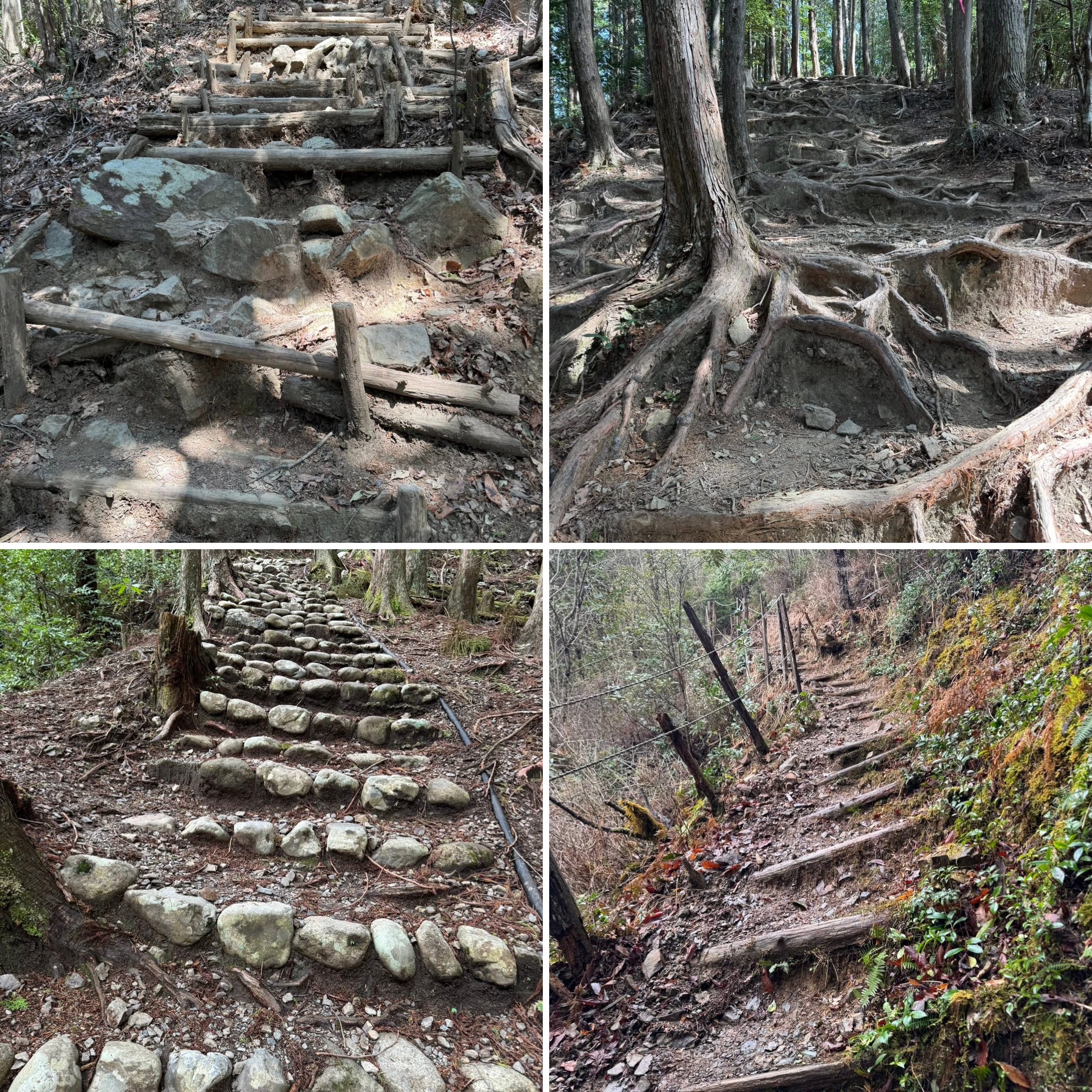
Although my first day was only 3.9km, it involved steep climbs on uneven dirt trails full of tree roots and rocks. I found I had to stop frequently to catch my breath while Waka seemed to glide up the trail, as nimble as a mountain goat and not even using trekking poles. I felt silly for asking her often how many more climbs we had (like a little kid asking “how much farther?”). I asked Waka whether the next two days would be as difficult and if she thought I would be okay on my own. (Self-doubt had creeped in.) She told me to be careful on the downhill sections as they could be very slippery, especially in the rain. With the warmer weather she also cautioned me to watch out for snakes, in particular the Japanese Pit Viper, a highly poisonous snake. Waka’s final piece of advice was to walk like a cow not a horse. Going slower like a lumbering cow would be easier than trying to rush up the mountains like a horse. When we reached the last shrine for the day, one of the oldest buildings on this section of the trail, shaded by an 800-year old camphor tree, Waka insisted we pray and thank the deities for bringing us safely up the mountain. (I also prayed I didn’t see any snakes.) I was sad when we parted, apprehensive about how the remainder of my trek would be without Waka to keep me safe. On Day 1 I had logged 11,854 steps and climbed the equivalent of 102 flights. There was still much more climbing to go.
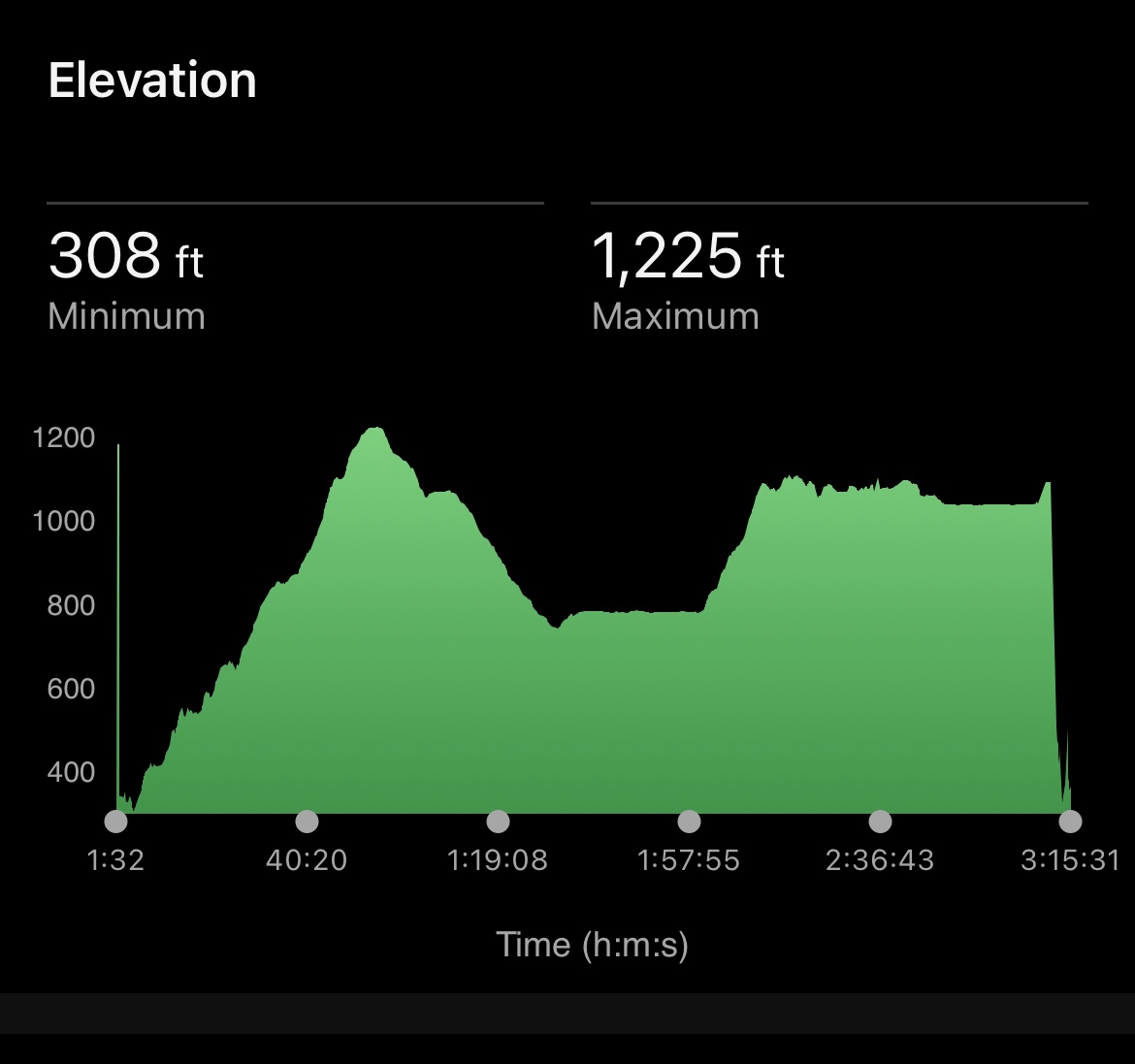
Day 2 was longer, about 12.9km. Leaving Takahara the trail was initially paved but almost straight up. At times my heart was pounding and I frequently needed to stop to catch my breath. There were many other pilgrims who started out at the same time and similarly were taking breaks during that climb. The trail soon became uneven dirt trails through forests like those I had walked on the previous day. In my brain I heard Waka telling me to walk like a cow. In Montana I have ridden horses behind many cows ambling along. I pretended to be one of those cows and found it was easier to keep going. After passing the remains of a tea house, the trail started downhill. Easy, right? I quickly discovered the downhill sections were even more challenging than the climbs. The narrow trail required people to walk single file and carefully tread to avoid tripping on tree roots and rocks. One misstep and it would be a header into a rock and the end of my pilgrimage.
The trail into the village of Chikatsuyu and on towards my final stop for the day in Tsuguzakura-oji. was paved. In 1109 a pilgrim had written about a cherry tree that had been grafted on a Japanese cypress; the name “Tsugizakura” means “grafted cherry tree.” Around this shrine was a grove of cedar trees, some as big as 8 meters in circumference and believed to be up to 800 years old. Day 2 was done and I had obtained all 7 stamps. I had logged 27,035 steps and climbed 168 flights. It was easy to fall asleep that night, even if I was again sleeping on a tatami floor. Getting up off the floor in the morning might not be as easy.
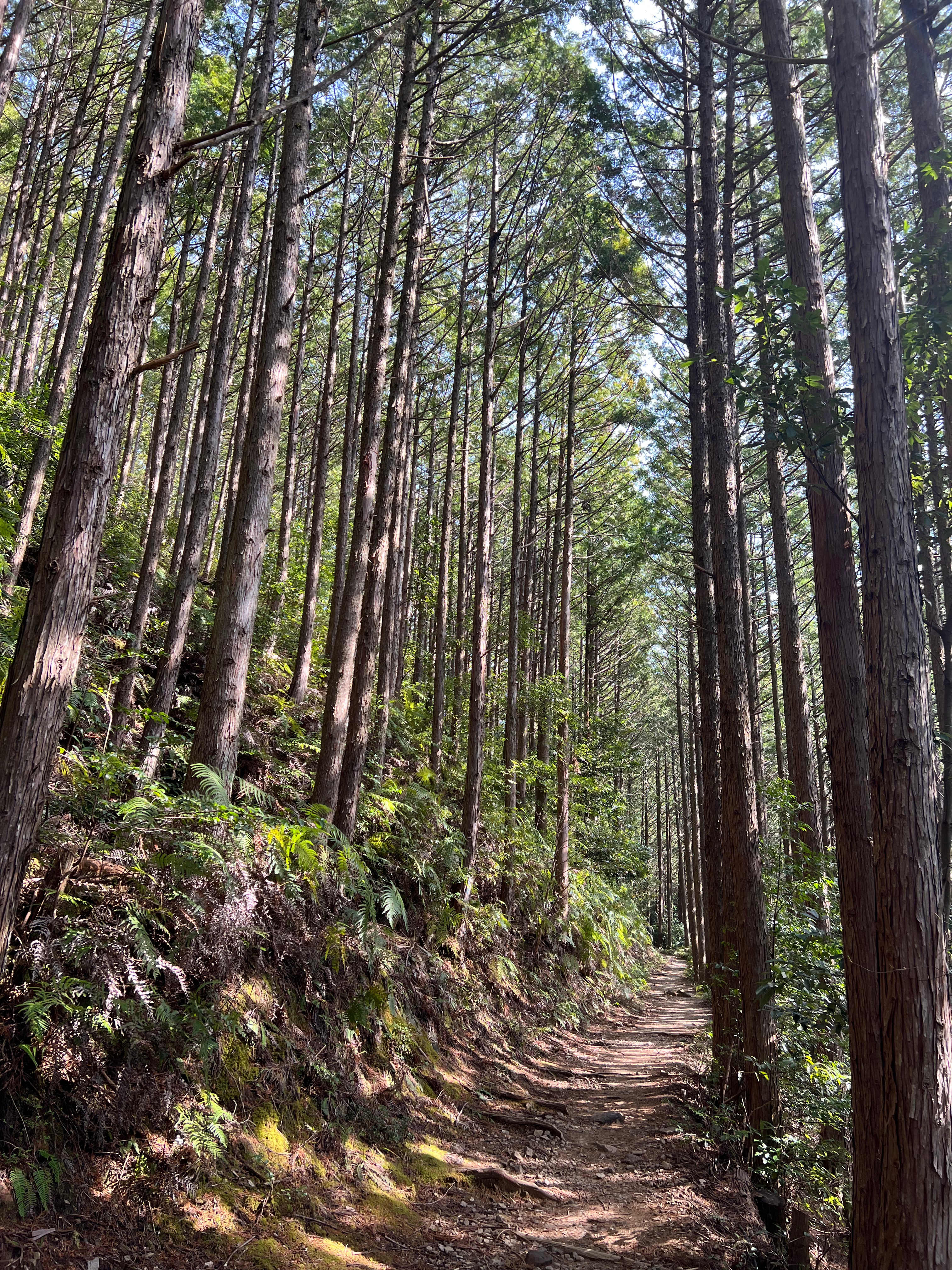
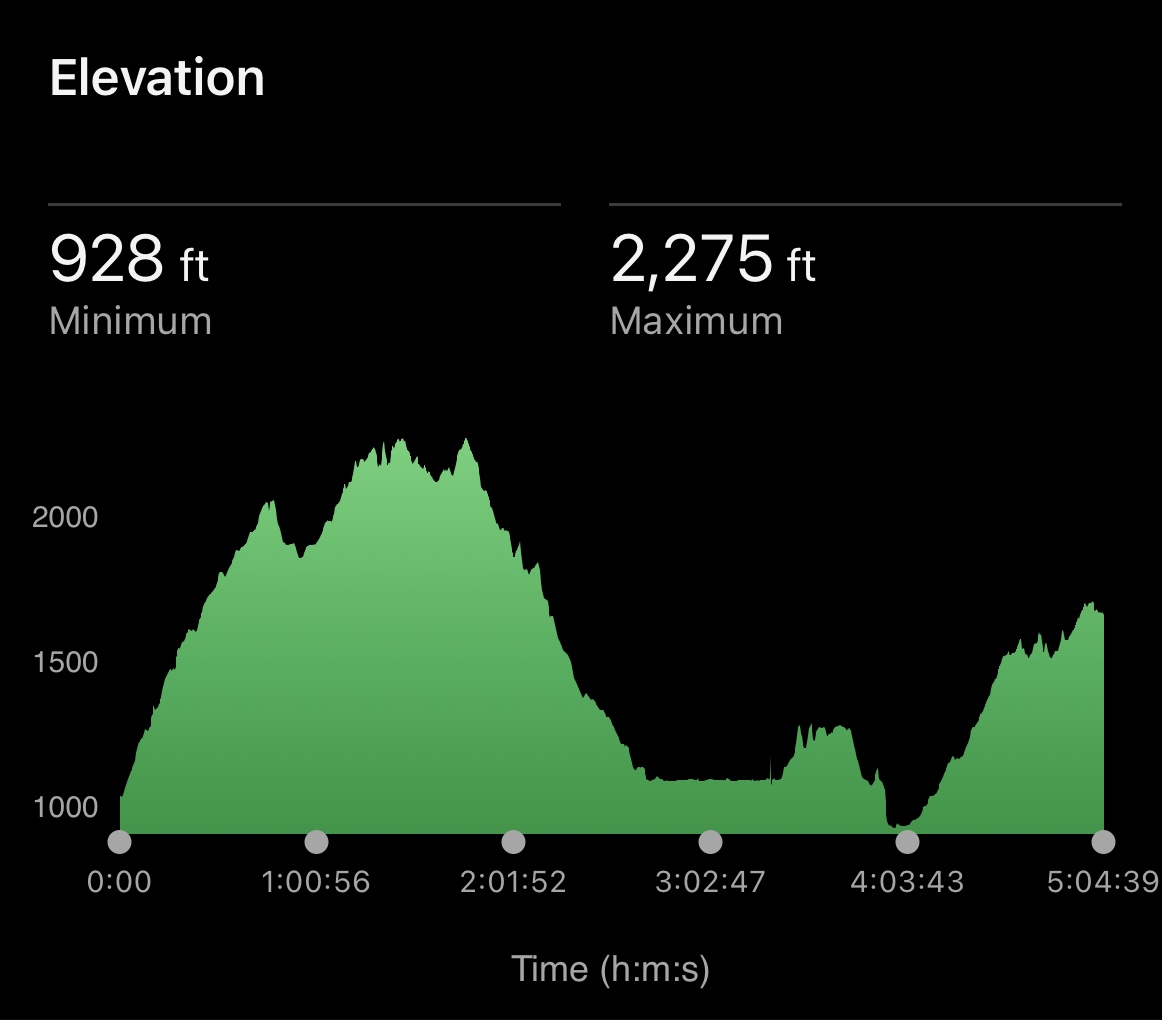
On Day 3 I awoke at 1AM, anxious to get moving and hopefully beat the rain that was expected in the afternoon. This was going to be my longest day of my Kumano Kodo – 21km. I decided to shave 4.9km off my hike (and avoid another climb through a mountain pass) by taking a bus to a spot further along the trail. I would still be able to collect the 8 stamps I needed for my Dual Pilgrim. A number of other pilgrims had the same idea and soon we were all huffing and puffing up the rocky and uneven dirt trail. It was along this section that I took a small spill, twisting my ankle and bending one of my trekking poles. I was in a section with no Internet or cell service. Self-extraction was my only option. It was here that I started asking Jane to help me finish. I focused my brain on each step, visualizing my throbbing ankle as strong and pain free, though it really wasn’t.
I stopped at the Hosshinmon-oji shrine at the top of the last pass to say a prayer for the remainder of my journey. Hosshinmon-oji is known as the “gate of awakening of the aspiration of enlightenment”. It is here that pilgrims released themselves from the six Buddhist realms of mortal reincarnation, thus finally attaining Buddha hood; the six realms being hell, hungry ghosts, beasts, demons, humans, and heavenly beings. Passage through this gate marked the initiatory death and rebirth in the Pure Land. By being reborn in Kumano’s Pure Land Paradise pilgrims were confirming Amida Buddha’s promise of salvation after death. I had achieved Buddha hood.
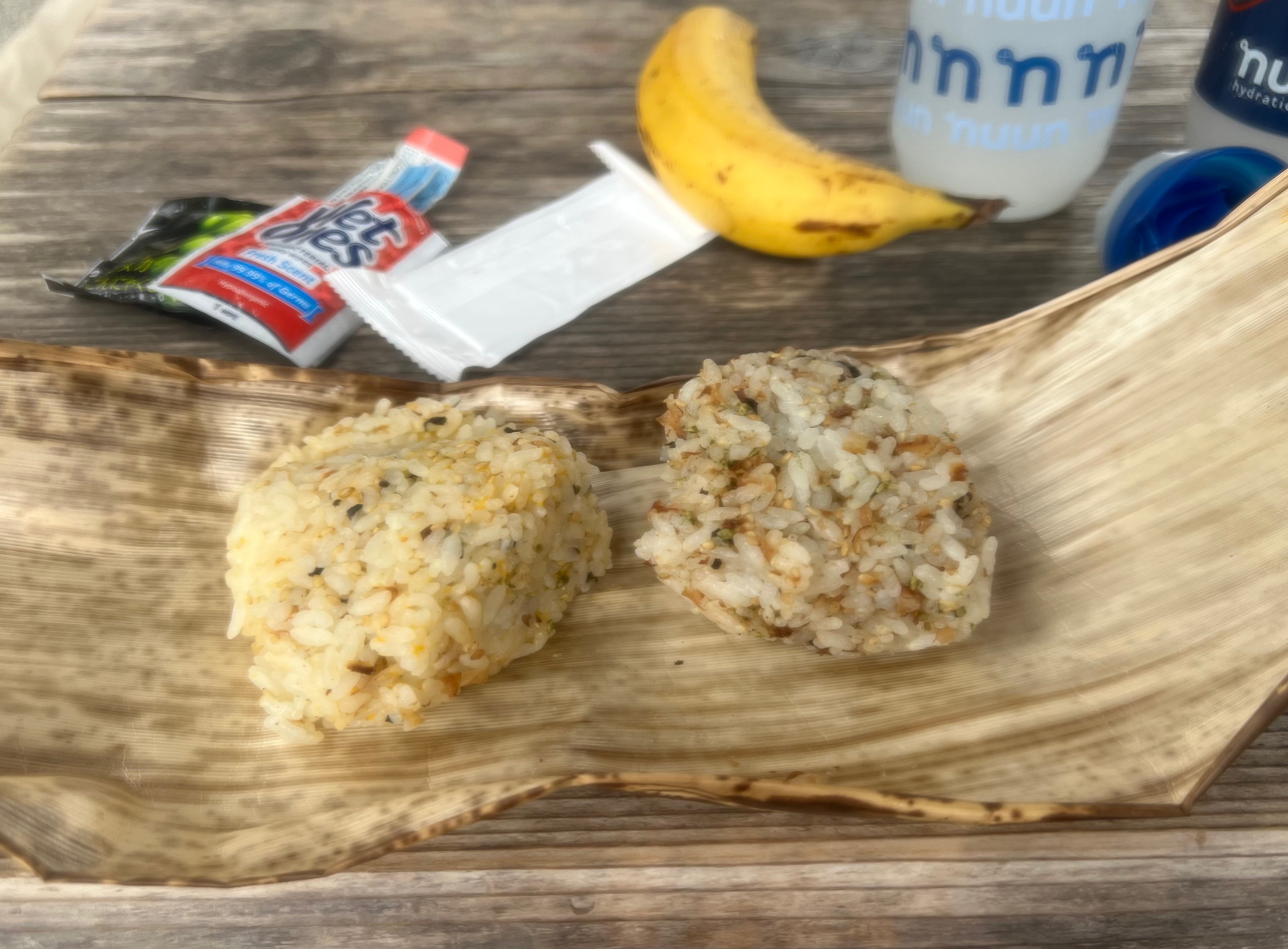
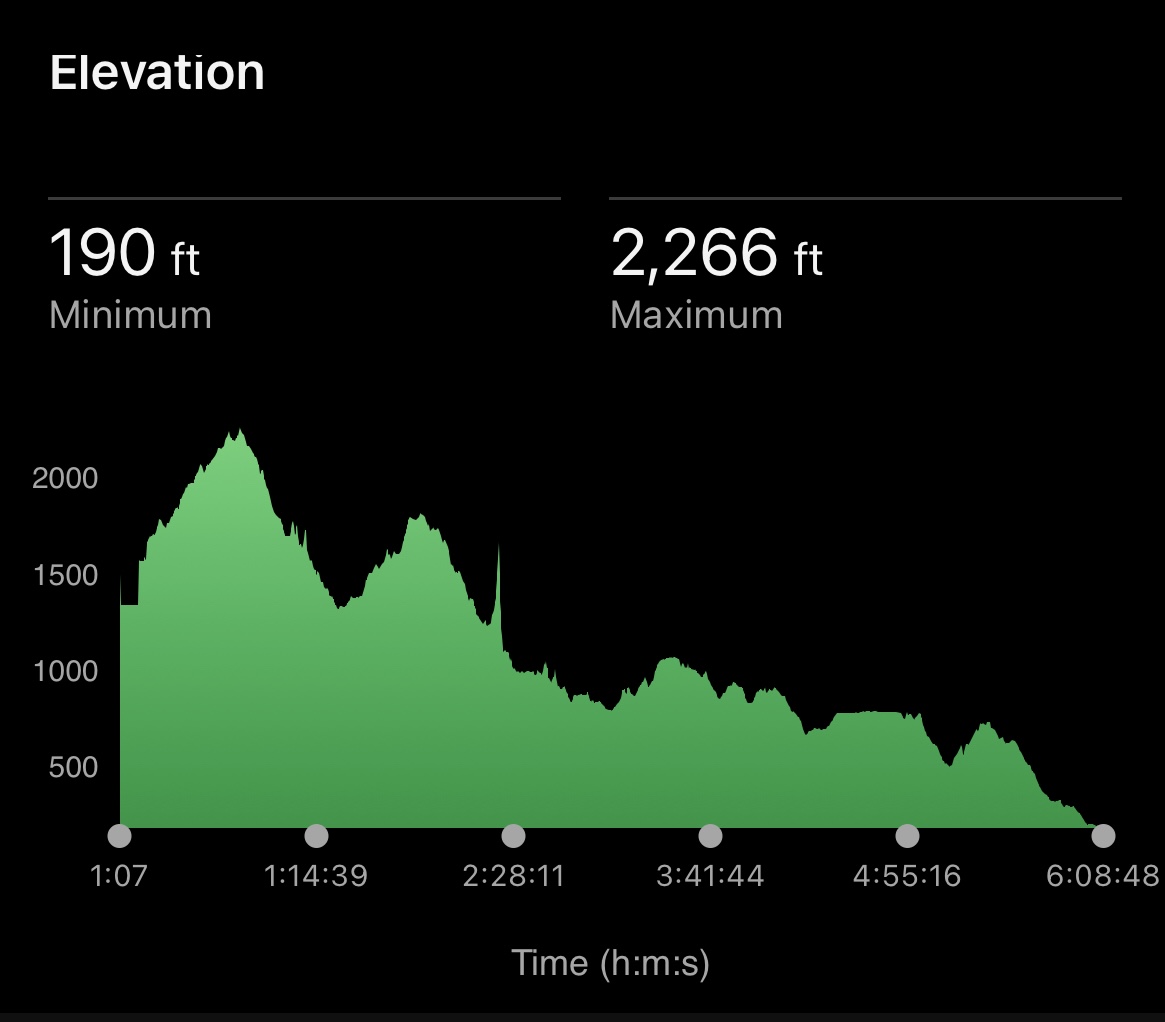
I had been hiking for over 4 hours and decided to stop to eat my lunch of rice balls and dried fish. I came across a covered rest area where many pilgrims were having lunch. I sat down at a table and opened up the lunch box. I was happy to discover there were small cookies and candies as well as veggies and rice balls the size of tennis balls wrapped in bamboo leaves, the ultimate earth-friendly way to pack a lunch! The rain started as I was eating and the pilgrims around me started to head back out on the trail. I passed on eating the rest of my lunch and hoped the rain would not make the rest of my hike unpleasant. Only 7km more to go and I would reach Hongu.
Unfortunately the light drizzle quickly became a downpour. By the last few kilometers the rain was very heavy. I worried my last two stamps would be washed out. It was a storm where keeping anything dry would be impossible. I finished Day 3 with 33,358 steps but only 121 flights climbed. I was soaked to the bone but happy when I received my Dual Pilgrim certificate.
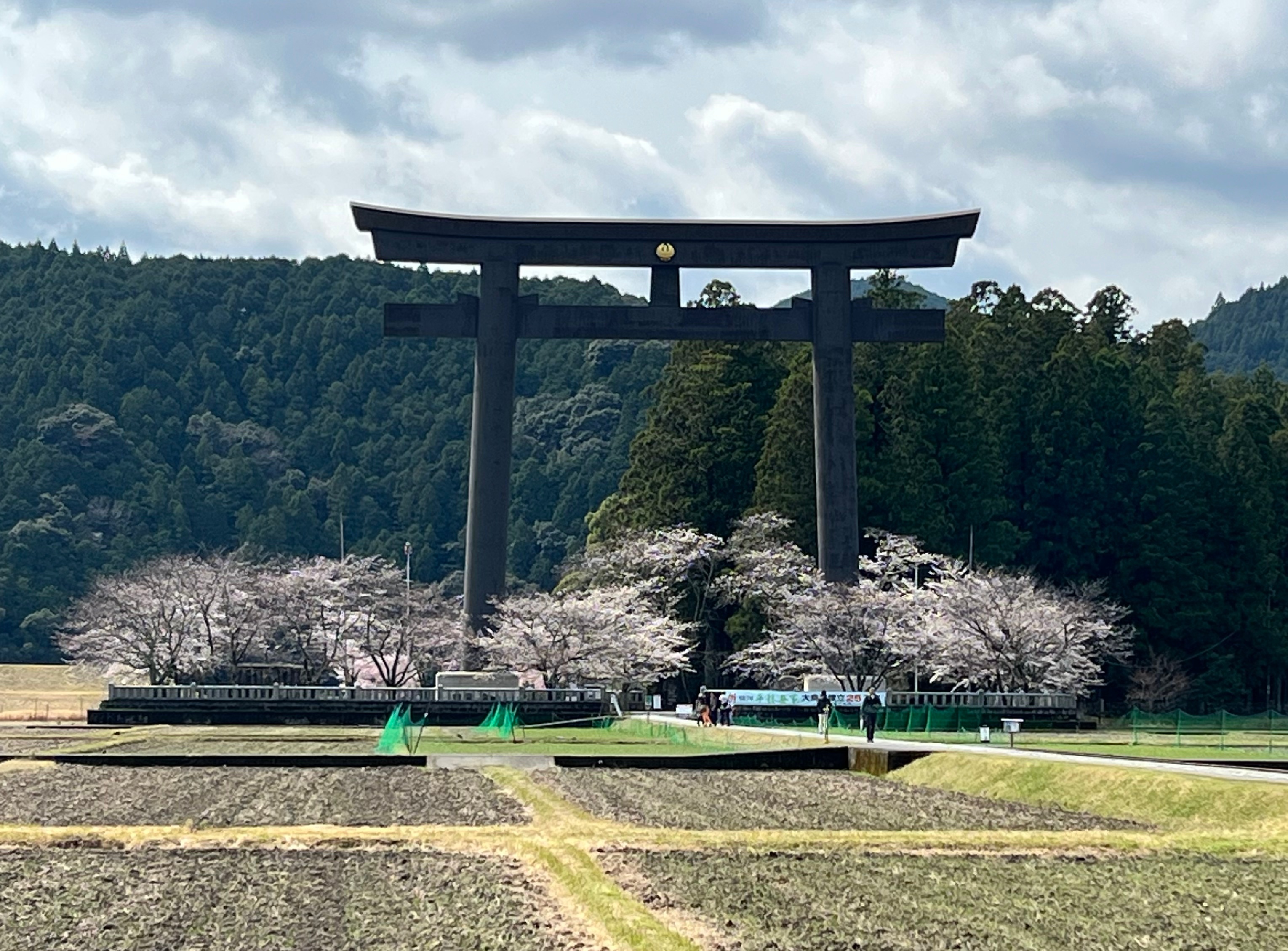
I spent the night in an area known for its hot springs or onsen. The guest house where I stayed had a private onsen where I was able to soak my tired muscles. The next day I took a rest day and returned to Hongu to receive my golden scallop shell and the Dual Pilgrim ceremony where I got to beat the large Taiko drum outside the shrine to express my feelings, emotions, and thoughts. I had completed my goal and I felt at peace. I walked around the shrine admiring the cherry blossoms, Tori gates, and saki casks.
Having spent 3 days climbing mountains, on Day 5 I took a bus to Shingu to visit Kumano Hayatama Taisha, Gotobiki-iwa and Kamikura-jinja. Of course one can’t have a day on the Kumano Kodo without climbing something. The 538 step staircase up to Gotobiki-iwa and Kamikura-jinja was steep and irregular. I started questioning why I choose to do things that are so physically demanding. This trip had been the most difficult thing I had ever done. Day 5 only 17,466 steps and 21 flights climbed.
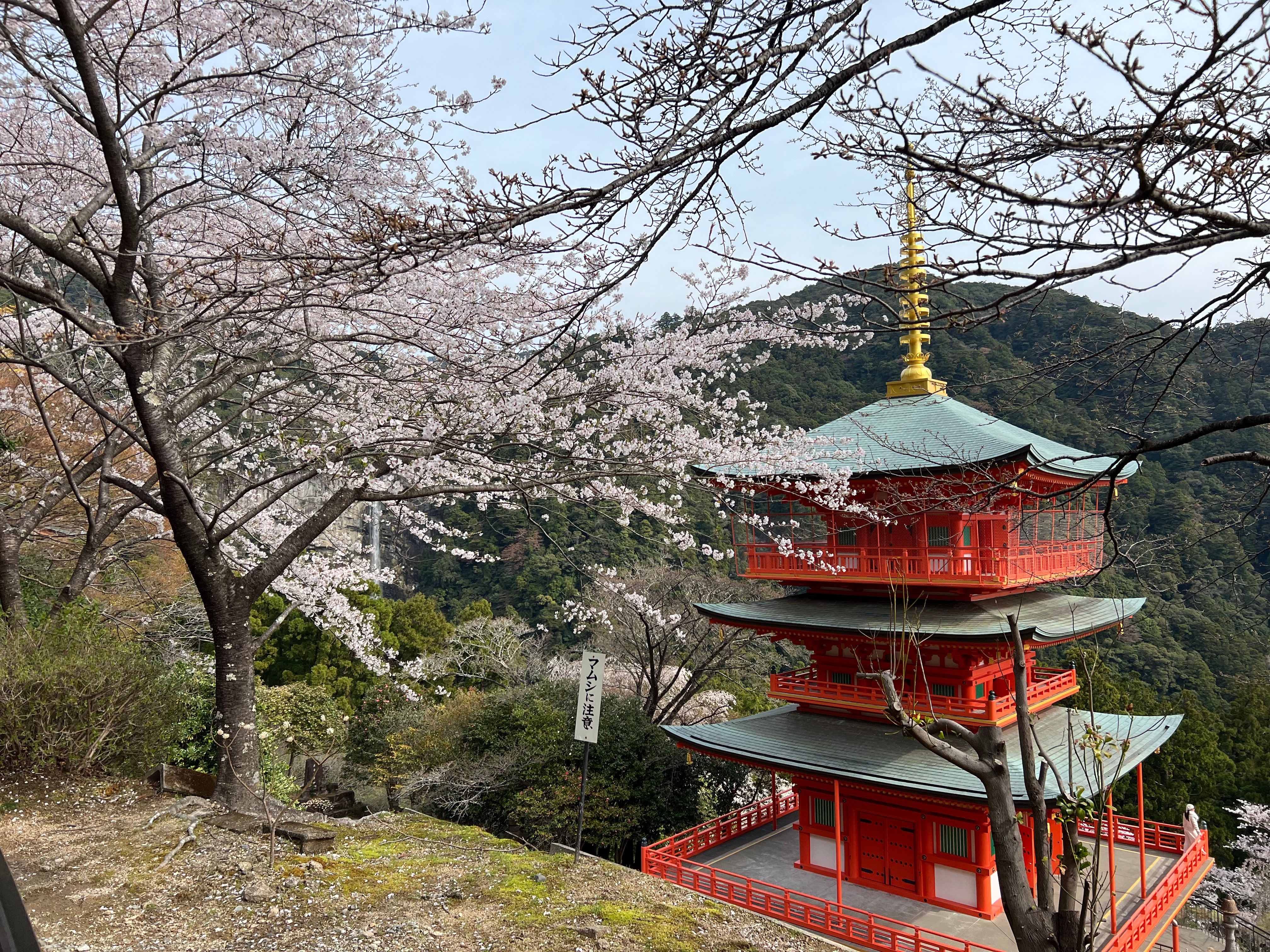
My last day I took a bus to Katsuura to visit Kumano Nachi Taisha, the Three-Storied Pagoda overlooking the Nachi Waterfall (the scene from that old magazine article). But first I had to climb stairs, lots of them (over 300 though there were even more stairs between all of these shrines). The Nachisan area was full of cherry blossom trees. The waterfall is the tallest waterfall in Japan and can be seen from far out in the Pacific Ocean. The spray from the waterfall is believed to have benefits to prolong life. There is also a pool of longevity water from the waterfall for drinking in case you don’t feel the spray. Final day stats 17,298 steps and 81 flights climbed.
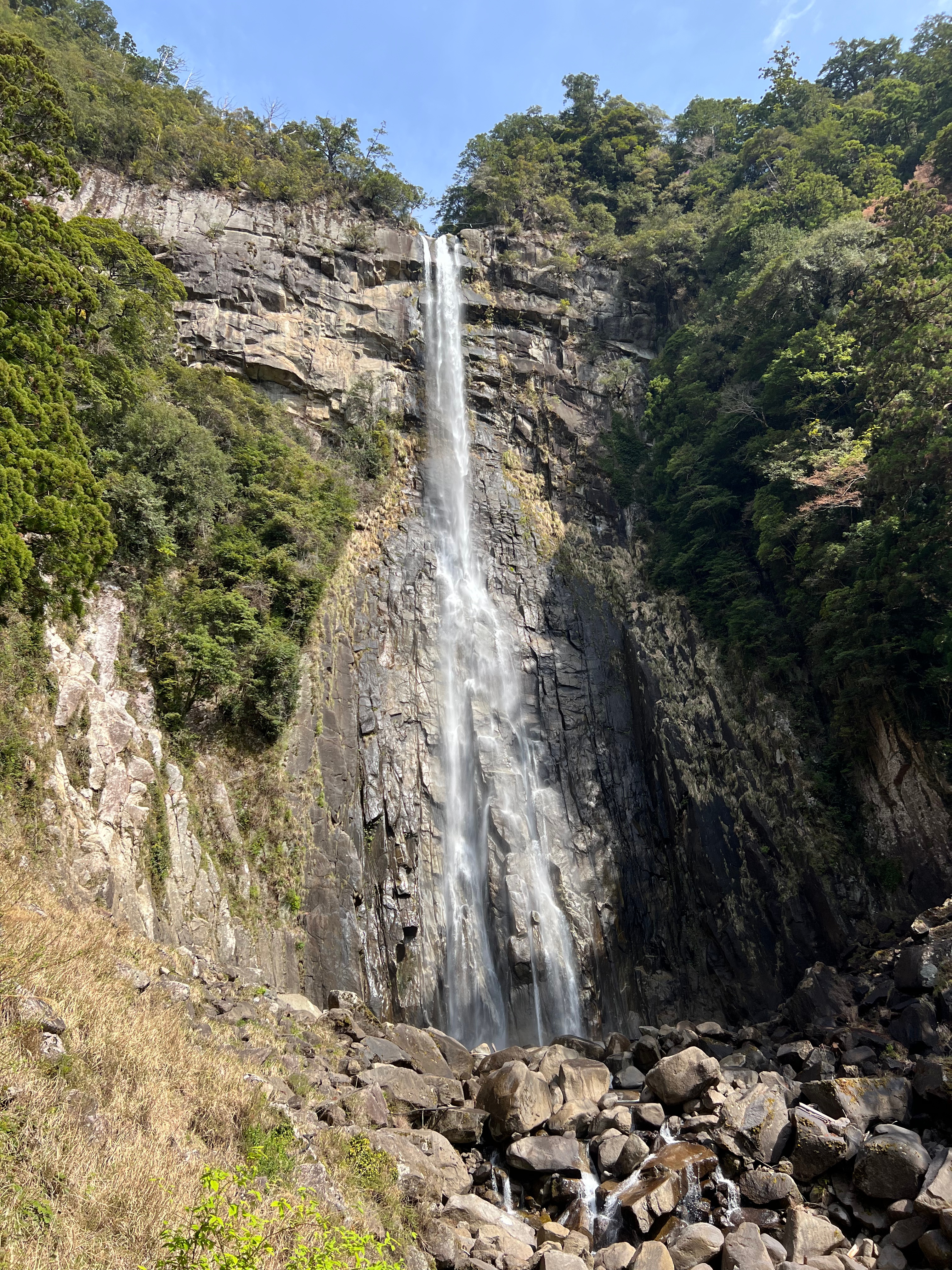
When I hiked back down into Katsuura, I felt I had achieved everything I wanted to on this trip. I visited the Three Storied Pagoda and had seen the Nachi Waterfall – a goal spawned by a magazine article. I completed this adventure with Jane – she was always on my mind as I navigated the dirt trails paved with rocks, roots, and scary stairs. Personally I became a Dual Pilgrim. It required me to complete a hike that was the most difficult thing I have ever done. Although I wasn’t able to crawl through the cave to be reborn or drink from the waterfall to prolong my life, I passed the gate required to achieve Buddha hood. More importantly I found the peace I needed to move forward.
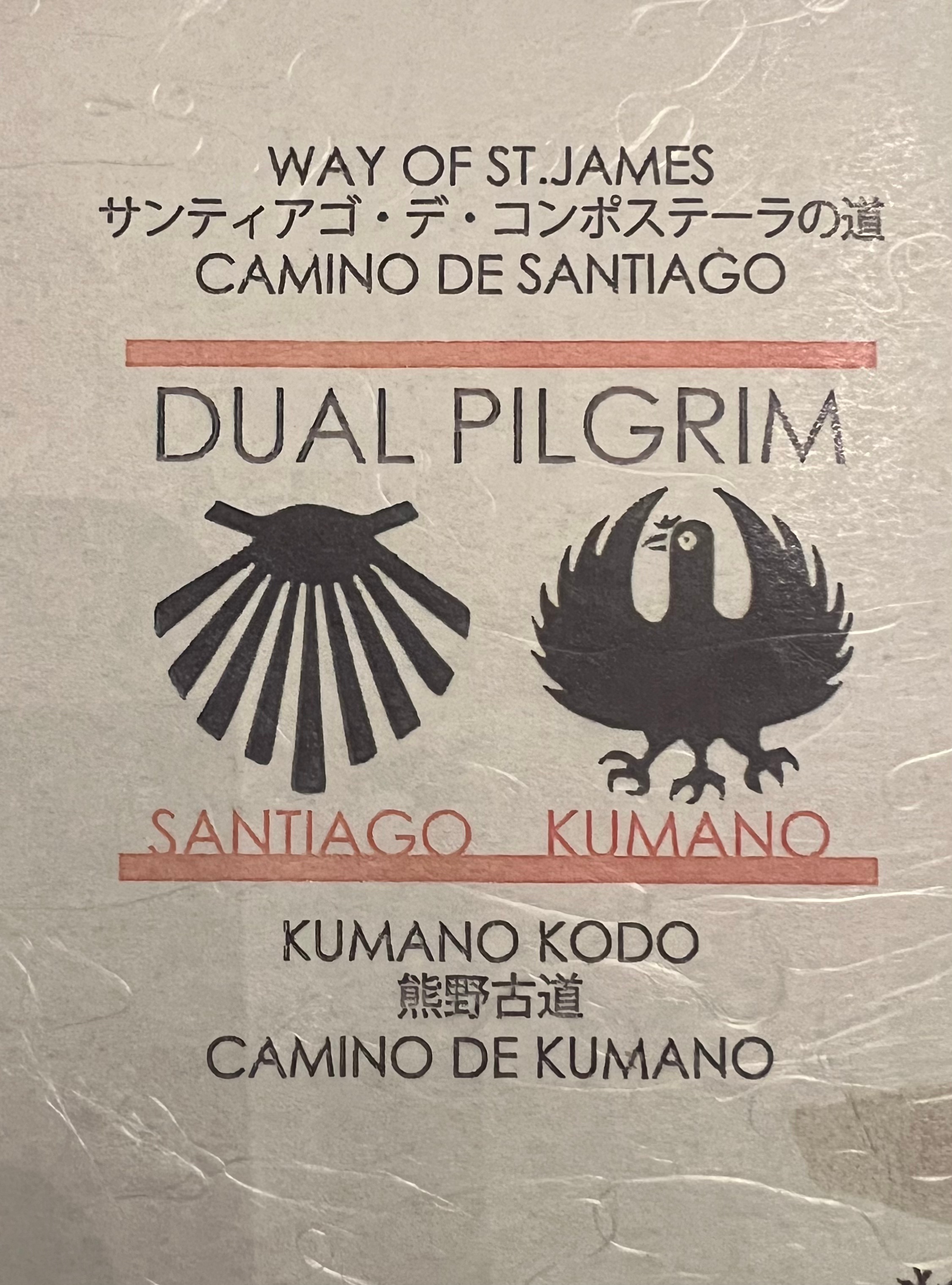
My Dual Pilgrim Certificate with the Scallop representing the Camino de Santiago and the Three-Legged Crow representing the Kumano Kodo. The three legs reflect the three virtues of the main diety: Wisdom, Benevolence, and Valor
Interested in walking the Kumano Kodo? I worked with the Tanabe City Kumano Tourism Bureau to arrange my accommodations in guest houses, luggage transfers, lunch boxes, and a guide for my first day. Unlike the Camino where I arranged lodging only 1-2 days in advance, the Kumano Kodo is more remote and rural with fewer resources so you need to make all your arrangements months in advance. The tourism bureau serves as an official community reservation system for the region to connect local businesses with domestic and international visitors. It was my one-stop resource for everything I needed. In November I reserved and paid for all the services I needed for my March trip. Working with the Tanabe City Kumano Tourism Bureau is the only way I would recommend walking a Kumano Kodo route.
Life is either a daring adventure or nothing at all.
Helen Keller
 Adventures of a Funatical Runner
Oh! What a powerful post! Those tricky stairs would do me in. Well done on such an amazing achievement! Linda 👏
LikeLike
Congratulations! What an amazing and inspiring accomplishment! Loved reading about your adventure and hearing about your healing, Dual Pilgram status and Buddha hood! Truly exceptional.
LikeLike